The Iodine Protocol
Step-by-step educational guide to an iodine nail-care routine
Before you begin: This page is educational and is not a diagnosis or prescription. Ask a healthcare professional first if you have diabetes, poor circulation, open skin, thyroid disease, iodine allergy, immune suppression, or if you are pregnant or breastfeeding.
What You'll Need
- Povidone-iodine (iodophor) solution — 2% or 10% (Betadine brand or generic). ~$3-8 per bottle.
- Nail file or emery board — to thin the nail surface.
- Cotton swab or dropper — for precise application.
- Patience — 6-24 months depending on your age.
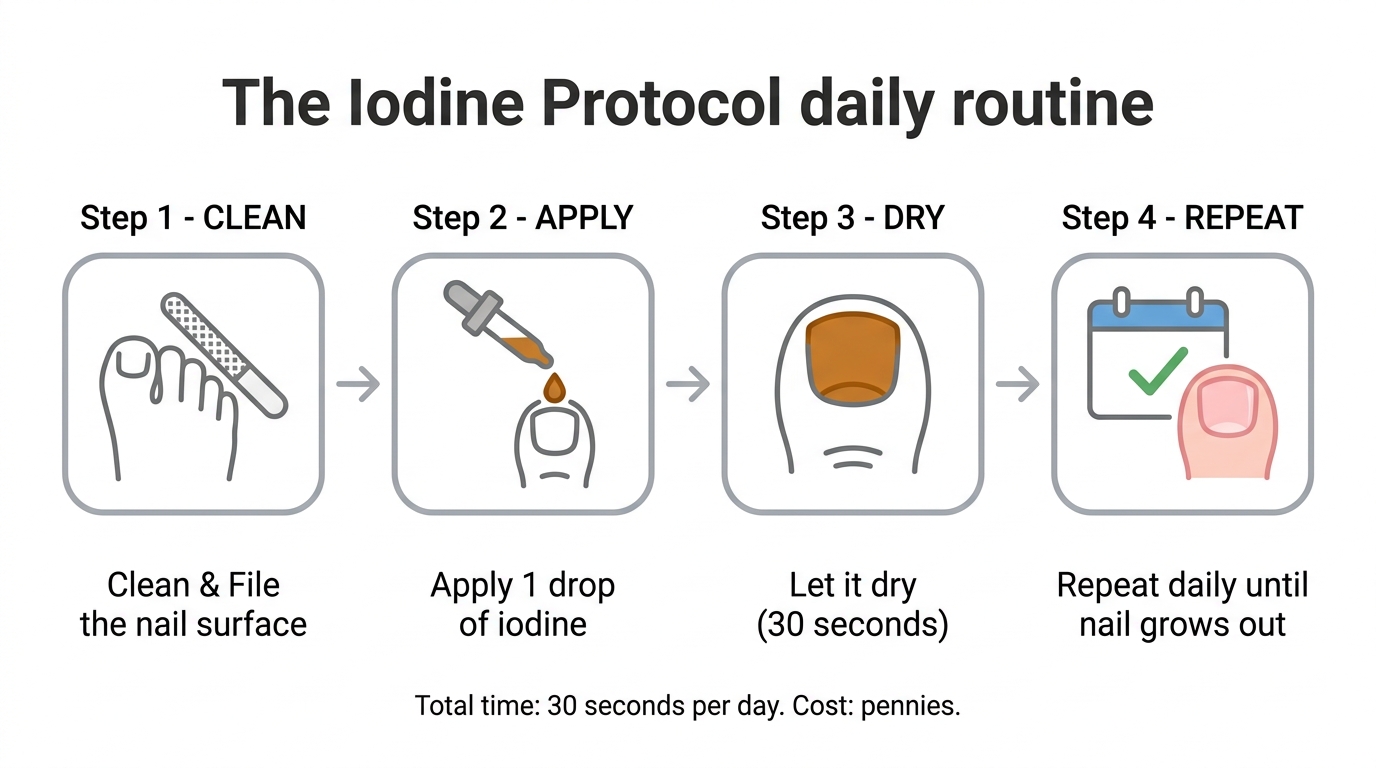
Step-by-Step Daily Routine
Step 1: Prepare the Nail
Wash your foot with soap and water. Dry thoroughly — especially between toes.
Gently file the top surface of the affected nail. This thins the nail plate and creates microscopic channels for the iodine to penetrate deeper. Don't file so hard that it hurts — just enough to remove the shiny top layer.
Step 2: Apply Iodine
Using a dropper or cotton swab, apply one drop of povidone-iodine solution to the affected nail. Spread it to cover:
- The entire nail surface
- Under the free edge of the nail
- Around the cuticle and nail folds
The amber-brown liquid will naturally seep into cracks and gaps in the damaged nail.
Step 3: Let It Dry
Allow 30-60 seconds for the iodine to dry. It dries quickly and leaves a thin antimicrobial film that continues working for hours.
Do not rinse or wipe off. The residual film is designed to release iodine slowly over time.
Step 4: Repeat Daily
Consistency is everything. Apply once daily, every day, until the healthy nail has completely grown out.
Missing occasional days is fine — but prolonged breaks allow spores to recover.
How Long Will It Take?
Your nail must grow out completely while protected by iodine. This depends on your age:
| Age | Nail Growth Rate | Minimum Treatment Duration |
|---|---|---|
| Under 40 | ~1.5-2 mm/month | 6-9 months |
| 40-60 | ~1.0-1.5 mm/month | 9-12 months |
| 60-70 | ~0.8-1.0 mm/month | 12-18 months |
| 70+ | ~0.5-0.8 mm/month | 18-24 months |
First visible results: in the published case reports, a sliver of clear nail at the base appeared within the first weeks of daily use. Your timeline depends on age and how much of the nail is affected — and the old infected nail must grow out completely before you stop.
After the Nail Clears: Maintenance
Once a healthy nail has fully grown out, reduce to 1-2 applications per week as maintenance. This prevents reinfection from spores that may remain in your shoes or environment.
Continue maintenance for at least 3-6 months after visible clearance.
What to Expect
| Timeline | What You'll See |
|---|---|
| Weeks 1-4 | No visible change is expected yet — nails change slowly. |
| Months 2-3 | A sliver of clear pink nail appears at the base (the "half-moon"). |
| Months 4-6 | The clear zone expands. The yellow/thick part moves toward the tip. |
| Months 6-12+ | The old infected nail is gradually clipped away as healthy nail replaces it. |
How the Evidence Compares
Iodine is not a proven cure for nail fungus, and being honest about that is part of this site's purpose. Here is how the published evidence for iodine compares with prescription options, so you can weigh choices with your clinician:
| Approach | Evidence level | Key published numbers |
|---|---|---|
| Iodine (tincture or povidone-iodine) | Case reports + one small retrospective review | A 2006 CMAJ case report described improvement with one drop of 2.5% tincture daily. A 13-patient review of dilute povidone-iodine in DMSO reported 8 of 13 culture-negative at 24 weeks. |
| Efinaconazole 10% (prescription topical) | Two Phase 3 randomized trials | At week 52: mycological cure 53.4–55.2%; complete cure 15.2–17.8%. |
| Oral terbinafine / itraconazole | Randomized trials, meta-analyses | Cure rates commonly reported around 30–40%, with inconsistent endpoint definitions; oral therapy requires monitoring and carries systemic risk. |
What this means: iodine is cheap and accessible, and published cases describe improvement, but no large controlled trial supports it as a first-line treatment. Prescription options carry stronger evidence — and their own costs, risks, and access requirements. This page exists to explain the iodine approach accurately, not to oversell it.
Tips for Success
- Treat athlete's foot too — if you have tinea pedis (foot fungus), care for the whole foot as well. Untreated athlete's foot is a common source of reinfection.
- Disinfect your shoes — spray shoes with antifungal powder or iodine solution. Replace old socks.
- Keep feet dry — change socks if they get sweaty. Wear breathable shoes.
- Use separate clippers — for infected vs. healthy nails to avoid spreading.
- Don't stop too early — the most common reason for "failure" is stopping treatment before the nail has fully grown out.