The Fungus Lab
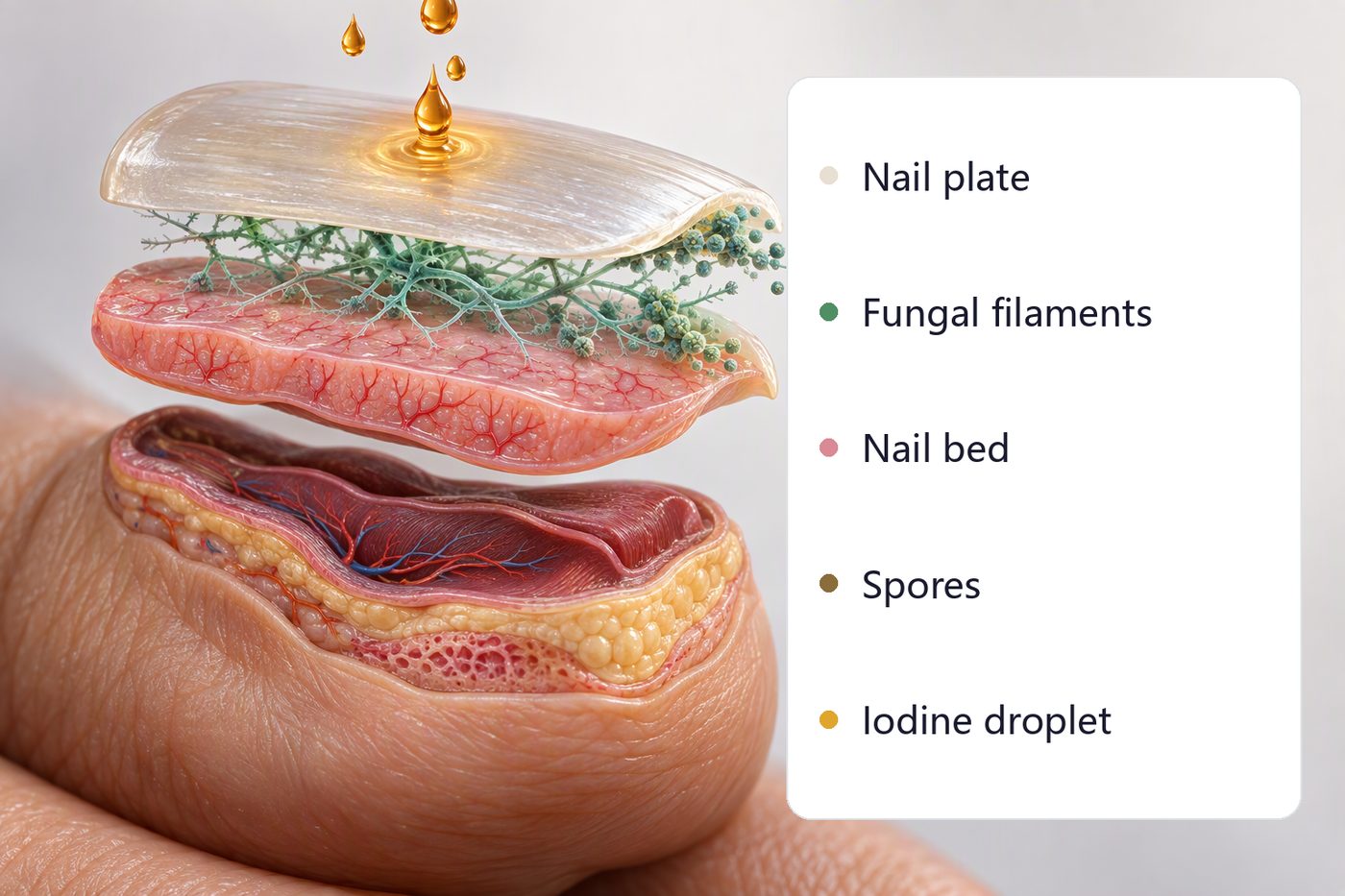
Watch a simplified nail-fungus colony germinate from one spore, creep along the nail bed, shed infectious spores — and then meet an iodine drop. Species sensitivity below is set by real in-vitro data; speeds and sizes are illustrative.
The simulation
Press Play. One spore has just drifted under the free edge of the nail…
What you are watching, stage by stage
- Landing. A spore (an arthroconidium — a tough, dried-out fungal segment) slips under the free edge of the nail, where a tiny gap between plate and bed is enough.
- Germination and spread. The spore swells and puts out a filament (a hypha) that creeps along the nail bed, digesting keratin. The yellow-brown shading on the nail is the damage trail.
- Sporulation. Along the hyphae, new arthroconidia break off. In real life these survive on skin scales, socks, and shoes; ordinary detergent washing removes few of them, while heat above roughly 50 °C does inactivate them.
- Iodine arrives. A drop lands on the nail surface. Where it can seep — under the lifted edge or into cracks — it kills on contact, fast. Where the nail is intact, it mostly sits on top. Contact is the whole game.
- The race. With a daily routine, the accessible fungal mass is killed faster than it regrows, and clear nail slowly grows in from the base. Skip days, and the colony reclaims territory from surviving spores and protected pockets.
The five species, with their real in-vitro numbers
Sensitivity values are measured log₁₀ reductions from a published EN 1275 suspension test (a European standard antiseptic test): 4 log means 99.99% killed, which is the bar for calling a product “fungicidal.” The five values sit in a narrow band, so what matters is whether a species clears that bar — not how far above it lands.
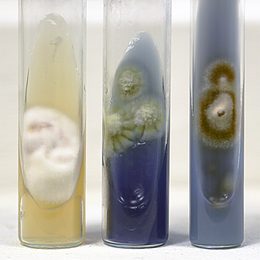
Red dermatophyte
By far the most common cause of toenail fungus. Slow but relentless. Log reduction 4.18 — killed.
Killed in vitro · log 4.18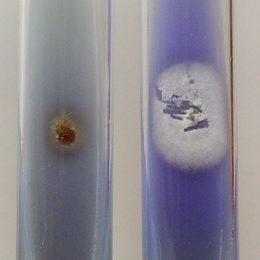
Powdery dermatophyte
Second most common; often the one behind athlete’s foot flares. Fast-growing, heavy spore producer. Log reduction 4.29 — killed.
Killed in vitro · log 4.29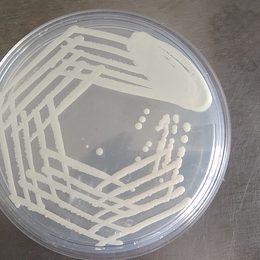
Budding yeast
More often discussed in fingernails and wet-work hands. Grows as round budding cells, not filaments. Log reduction 4.39 — killed.
Killed in vitro · log 4.39
Wrinkled yeast
Also known for surviving on dry surfaces. Log reduction 4.50 — killed, at the top of a narrow range.
Killed in vitro · log 4.50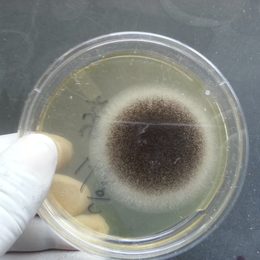
Black mold
A non-dermatophyte mold — a minority of cases, but the stubborn one. Log reduction 3.10: reduced, below the 99.99% fungicidal bar.
Reduced, not killed · log 3.10Culture plate photographs. T. rubrum (isolated from a toenail, Sabouraud dextrose agar): Medmyco, Wikimedia Commons, CC0. T. interdigitale belongs to the T. mentagrophytes complex; the plate shown compares T. rubrum with T. mentagrophytes (Medmyco, CC0). C. albicans, C. parapsilosis and A. niger on Sabouraud dextrose agar: Ajay Kumar Chaurasiya, Wikimedia Commons — the A. niger image is CC BY-SA 4.0, the other two are CC0. Colony appearance varies with medium, temperature and incubation time; culture is not a diagnosis on its own.
Share of infections varies by region and nail type; dermatophytes dominate toenails, yeasts are discussed more in fingernails, and molds such as Aspergillus are a recognized minority. A lab culture is the only way to know which one is in a given nail.
Five things this simulation is built to teach
- Spores are the reservoir. Killing today’s growth is not enough if arthroconidia survive in debris, socks, and shoes. This is why shoe and sock hygiene and maintenance after clearance get their own guides.
- Contact is the whole game for any topical. A drop on intact nail does little; the same drop at a lifted edge or crack reaches the colony. Filing gently and targeting edges exist to solve exactly this. See can iodine kill fungus under a toenail?
- The fungus races the nail. Nails grow millimeters per month; hyphae extend faster when conditions favor them. That is why even perfect routines are judged by clear nail growing in from the base — try the timeline calculator.
- Daily repetition beats heroic one-offs. In the lab, iodine kills contacted cells in seconds to minutes — but it does not leave a long-lasting film. Surviving pockets regrow within days.
- “Iodine didn’t work for me” can be literally true. Resistant organisms exist, thick nails block contact, and mixed infections happen. That is a reason to involve a professional, not to keep guessing.
Honest limitations
- Growth speeds, spore rates, and sizes are chosen for visibility, not measured in vivo; real-time studies of hyphal extension inside a living nail barely exist.
- The EN 1275 data is from suspension (test-tube) tests at set contact times. A nail is keratin, not a test tube — penetration through intact nail is poor, which the simulation represents but cannot quantify.
- The mold’s survival is exaggerated for visibility. The underlying fact is a threshold judgment (3.10 vs. a ≥4.00 bar), not a graded “30% survives” measurement.
- The four organisms iodine does kill sit in a narrow band (log 4.18 to 4.50), and that spread is within the study’s own margin of error. Read them as one group that iodine kills, not as a sensitivity ranking. Only the mold stands clearly apart, because it falls below the pass/fail bar rather than sitting lower on a scale.
- Single-species display only; real infections can be mixed, and species identification needs laboratory confirmation.
- Nothing here predicts any individual’s outcome. Decisions belong with you and a qualified clinician.
Common questions
Does iodine kill spores, or only growing fungus?
In published in-vitro suspension tests, povidone-iodine showed sporicidal activity against dermatophyte arthroconidia within about one minute of contact. Real nails are harder than a test tube: spores hide in debris and under thick nail where liquid may not reach.
Why does the black mold survive?
Aspergillus niger stayed below the fungicidal bar in EN 1275 tests (log 3.10 versus the required 4.00). The simulation exaggerates the visible difference; the pass/fail gap is real data.
Is this a real biological model?
No — a simplified visualization. Sensitivity numbers come from published suspension tests; speeds and the mold’s dramatic survival are illustrative.
How fast do toenails grow compared with fungus?
Toenails commonly grow about 1.5–2.5 mm per month, slower with age. Filamentous fungi can extend faster under favorable conditions, which is why the race is won by clearing the infection and letting clean nail grow in.
Sources behind the numbers
- Silva-Neves V, et al. Quality of life and therapeutic regimen management in onychomycosis patients and in vitro study of antiseptic solutions. Scientific Reports 2021;11:12789 — source of the EN 1275 log-reduction values for povidone-iodine against T. rubrum, T. interdigitale, C. albicans, C. parapsilosis, and A. niger (clinical and reference strains).
- Thongkham K, et al. Inactivation of dermatophyte arthroconidia… Veterinary World 2022;15:1373–1379 — povidone-iodine kills arthroconidia and hyphae within one minute in vitro; common detergent leaves <1 log reduction; heat above ~50 °C for 25 minutes inactivates.
- Capriotti K, et al. Dilute povidone-iodine against fungal biofilms and spores. Journal of Dermatology & Clinical Research 2018 — sporicidal activity against five fungal species and complete biofilm clearance versus fluconazole failure.
- Capriotti K, et al. Treatment of onychomycosis with dilute topical povidone-iodine in DMSO. Clinical Research Trials 2019 — 13-patient retrospective review.
- Case report: one drop of 2.5% iodine tincture daily for severe toenail fungus. CMAJ 2006;175(7):773 — single self-reported case.
Evidence note: suspension tests and small case series are not clinical trials of iodine for nail fungus. They tell us iodine can kill these organisms on contact; they do not tell us a bottle at home will clear any particular nail. Prescription options carry stronger trial data — see how the evidence compares.